REQUEST A QUOTE

/Insights
Commercial Decarbonisation Case Study: Industrial Units Achieve Grade A & B

When it comes to future-proofing commercial assets, Vital Direct helps clients identify the most cost-effective route to compliance with the proposed Minimum Energy Efficiency Standards (MEES) Phase 2 and full decarbonisation of commercial rental properties.
The current proposal suggests that by 2030, commercial properties must achieve a minimum Energy Performance Certificate (EPC) rating of Grade B to be legally let, with the certificate lodged on the government database. While this legislation is still at proposal stage and not yet confirmed under the Energy Act 2011, many forward-thinking clients are already acting, improving portfolios well beyond the current minimum requirement of Grade E.
What is an EPC Plus Report?
An EPC Plus report (also called a decarbonisation report) is a detailed technical assessment that identifies the most effective pathway for improving a commercial building’s energy performance. Unlike a standard EPC, which simply rates current performance, this advanced report provides:
- Estimated capital expenditure for each improvement measure
- Projected carbon emission savings
- Operational cost savings and payback periods
- Minimum technical specifications for upgrades
- Combined impact modelling showing how measures interact
- A clear compliance roadmap aligned with MEES Phase 2 requirements
This structured approach removes guesswork and provides investment certainty before capital is deployed.
Project Overview: Industrial Units in Caerphilly
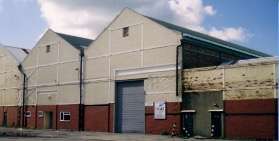
In this example, our client owned two industrial units in Caerphilly and wanted to improve, decarbonise, and future-proof the assets, not only to increase capital value, but also to ensure strong rental appeal in line with proposed MEES Phase 2.
Both units:
- Had similar footprints
- Were constructed in the 1980s
- Used gas boilers (fossil fuels) for heating
- Had outdated tungsten lighting
- Had poor insulation to internal walls
- Comprised approximately:
- 90% warehouse space
- 10% offices, toilets, kitchen/breakout areas
Step 1: Establishing the Baseline
The client’s target was clear: achieve Grade B for both units.
They first commissioned draft “as-is” EPCs to establish the baseline. Both units returned a Grade E.
Step 2: Commissioning the Decarbonisation Assessment
Vital then carried out detailed EPC Plus reports to determine the most effective improvement pathway.
These reports included:
- Estimated capital expenditure
- Projected carbon emission savings
- Operational cost savings
- Payback periods
- Minimum technical specifications for each improvement measure
- Combined impact modelling of measures
The “Rollercoaster Effect”: Why Combining Measures Matters
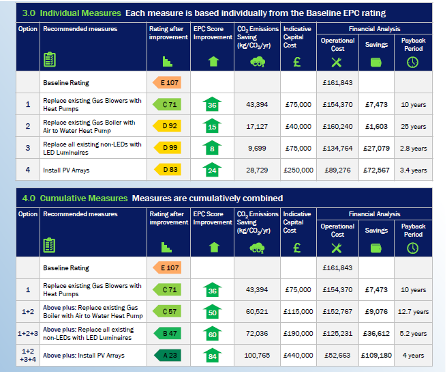
Section 3.0 of the report presents the financial breakdown for each suggested improvement.
Section 4.0 is where the real value becomes evident.
This section demonstrates the cumulative impact of combining measures, showing how one upgrade influences the next. Rather than isolated improvements, the report models the building holistically, creating a clear pathway from:
Grade E to Grade A (Fully Electric, Decarbonised Asset)
This “rollercoaster effect” allows clients to:
- Understand interaction between measures
- Avoid over-specifying or under-specifying works
- Optimise capital investment
- Make informed strategic decisions
Step 3: Verifying Specifications Before Capital Spend
Before purchasing materials or commencing works, the client consulted their Mechanical and Electrical (M&E) and building contractors to scope and specify upgrades.
Crucially, they then commissioned a draft predicted EPC to confirm that the chosen specifications would achieve the desired rating.
Once Vital conducts a site survey and produces a draft EPC, a “digital twin” of the building is effectively created.
This allows:
- Scenario modelling
- Specification adjustments
- Outcome grade predictions
- Fine-tuning of performance targets
This process removes guesswork and significantly reduces risk before capital is deployed.
What Improvements Achieve Grade B EPC Ratings?
The specific improvements required vary by building type, age, construction, and current condition. In this case study, the works undertaken included:
- Complete removal of gas infrastructure
- Installation of air conditioning split systems (Air Source Heat Pumps, ASHP) in office areas
- Infrared radiant heating in warehouse areas (comfort heating)
- Full LED lighting upgrade (150 lumens per kWh lamps)
- Additional insulation to office walls and ceilings
These measures were selected based on the detailed modelling in the assessment, which identified the most cost-effective combination to achieve the target grade.
The Results
After works completion, Vital revisited the site to verify installations and prepare new draft EPCs prior to lodgement.
- Unit A achieved an excellent Grade A
- Unit B achieved the target Grade B
The client was delighted, not just with the ratings, but with the structured, data-driven process that ensured investment certainty and long-term asset resilience.
How Does MEES Phase 2 Affect Commercial Landlords?
The proposed MEES Phase 2 regulations, expected to take effect by 2030, will require all commercial rental properties to achieve a minimum EPC rating of Grade B. Properties failing to meet this standard will be unlawful to let.
This represents a significant step up from the current Grade E requirement and will affect thousands of commercial landlords across the UK. Forward-thinking property owners are already taking action to:
- Protect asset values and rental income
- Avoid last-minute compliance costs when regulations are confirmed
- Attract quality tenants who increasingly demand energy-efficient premises
- Reduce operational costs and carbon emissions
- Future-proof portfolios against further regulatory tightening
A comprehensive decarbonisation assessment provides the roadmap to achieve these objectives in a cost-effective, strategically planned manner.
Why This Approach Matters for Commercial Decarbonisation
A comprehensive technical assessment (also known as a decarbonisation report) provides:
✔ A clear compliance roadmap
✔ Financial clarity before capital spend
✔ Carbon reduction modelling
✔ Risk reduction through predictive grading
✔ Long-term portfolio strategy alignment
For landlords looking to stay ahead of MEES Phase 2 and protect asset value, this structured approach provides confidence and measurable results.
If you are considering similar projects, contact Vital today on 0345 111 7700 for a no-obligation quote.